
MARKET ACCESS
You can sell across the EU without opening a company here.
EFC lets a business from outside the EU import and sell across the EU without its own EU company. We can act as the importer, handle your VAT registration, and file the VAT on your sales to consumers.

WHAT IT COVERS
Three functions cover the import and the VAT.

-
Importer of Record
An importer of record is the party named as importer on the customs declaration. Every import into the EU needs one. We can take that role, so you do not need an EU company to import.
Importer of Record -
Fiscal representation
A fiscal representative is an EU-based party that handles your VAT filings. A business from outside the EU often needs one to register for VAT. We include it in the operation, and tax advice stays with your own adviser.
Fiscal representation -
OSS VAT across the 27
The One-Stop-Shop (OSS) is one EU VAT registration for distance sales to consumers in other member states. It covers consumer sales only. We can run the OSS filings as your orders ship.
OSS VAT across the 27
GETTING THE GOODS IN
Two ways to bring stock into the EU.
Release for free circulation is the customs step that turns non-EU goods into EU goods. After release, the goods can move and be sold anywhere in the single market. Duty and import VAT fall due at that point.
Before any of the three functions matters, the goods have to enter. There are two ways in.
-
Release into free circulation, the usual route
On this route the goods are released as they enter the EU. Duty is paid then, based on the goods' tariff code, origin and customs value. Where the importer qualifies, import VAT is declared and deducted in the same VAT return, so no cash is paid at the border.
Whether that is available, and how much can be deducted, depends on the importer's own VAT position. From then on the goods are EU goods. Selling them on to a business in another member state is an intra-Community supply: a sale between EU countries, not an import.
-
Hold under bond, and release as needed
On this route the goods go into a customs warehouse, also called a bonded warehouse. Duty and import VAT are suspended while they stay there. Stock is released as it is needed, and each release is declared and taxed on its own.
Nothing is due on stock that has not been released. The extra handling makes sense for higher-value goods that move in smaller volumes, and for slow-moving or high-duty ranges.
What you arrange
Whichever route the goods take, you insure them yourself. Under the CMR Convention, the treaty on international road haulage, a carrier's default liability is capped by the cargo's weight, whatever its value.
You arrange cover on stock and in transit, in your own name, and you decide its scope with your insurer. Insurance sits outside our work: we do not sell or place policies, and we do not advise on cover.
Selling on, once the goods are in
A sale to a business in another member state can be zero rated: no VAT on the invoice, and the buyer accounts for it. The legal basis is Article 138 of the VAT Directive. A sale to a customer in the country where the goods were released is a domestic sale there, taxed under that country's rules.
THE MECHANISM
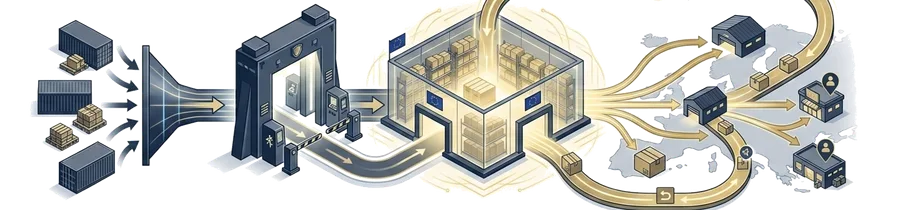
Cleared goods can move to any member state.
On the usual route, the goods clear customs once, when they arrive. The importer of record makes the import lawful, and fiscal representation covers your VAT registration. After that, the same stock can reach distributors, retailers and consumers anywhere in the single market.
HOW IT FITS
We run all three in the same operation that stores your goods.
This works on both routes: release on arrival and storage under bond. Separately, consumer products in scope of the General Product Safety Regulation (GPSR) also need a Responsible Person in the EU.
That is the EU contact for product safety authorities, a role we can hold. Deciding which markets to enter and how to grow sales in them is commercial work, and our business development team runs it with you.
Market access
Questions about importing and VAT without an EU company
What is the difference between releasing goods into free circulation and holding them under bond?
The difference is mostly when tax falls due, and how much cash sits in unsold stock. Where the goods end up is the same. On release for free circulation, duty is paid as the goods enter. Import VAT falls due at the same time, though a qualifying importer can settle it through the VAT return. The goods then count as EU goods and move on as intra-EU movements. Under bond, nothing is paid until stock is released, and each release is a separate declaration.
Do I need an EORI number to import into the EU?
Yes, if goods are declared to customs in your name. Every declaration is lodged against an EORI (Economic Operators Registration and Identification) number, which identifies a business to customs authorities. It is issued once and recognised at every customs point in the EU, whichever country the goods enter through. A VAT number is different: a single EU country issues it for VAT in that country. Whether you can use it to sell into other EU countries depends on the type of sale and the VAT scheme, not on the number.
My container lands in Spain but my stock is in Portugal. How does VAT work?
Customs duty is paid in the member state where the goods are released for free circulation. A container that lands in Spain can be released at the Spanish port. It can also travel to Portugal under transit, with duty suspended on the way, and be released there. That choice decides where duty is paid and where import VAT is accounted for. Where stock is sold on to VAT-registered businesses in other member states, the import can be set up without import VAT in Portugal. EFC sets this up case by case, for sales to businesses only, never for sales to consumers.
When can a sale to another EU country be zero rated?
Under VAT Directive Article 138, a sale to a VAT-registered business in another EU country can be zero rated. Since 2020 it needs proof the goods left, the buyer's VAT number and a correct recapitulative statement, a periodic list of intra-EU sales. A sale inside the country of release stays a domestic sale.

Import into the EU and sell across the single market.
Tell us where your goods come from and where they sell. We will map the import, the fiscal representation and the VAT.
Get a quote