
THE THIRD WAY
Distributor, classic 3PL,
or your own European operation?
EFC runs a European operating base for brands from outside the EU. With a distributor, your customers and part of your margin pass to them; with EFC, both stay with you. Where a logistics vendor leaves customs to you, EFC handles customs and the import in the same operation that stores the goods.
Selling across Europe is usually framed as a choice between two routes. You hand the market to a local distributor, or you appoint a logistics vendor and carry the complexity yourself. There is a third option: an operation inside the EU where the customer stays yours. The customs, tax, and returns run inside the same base.
TWO USUAL ROUTES
Two ways into Europe, and both cost you something.
Selling across Europe is usually framed as a choice between two answers. The first passes the market to a partner. The other hands you all the complexity. Each costs the brand something it should not have to give up.
-
The usual detour
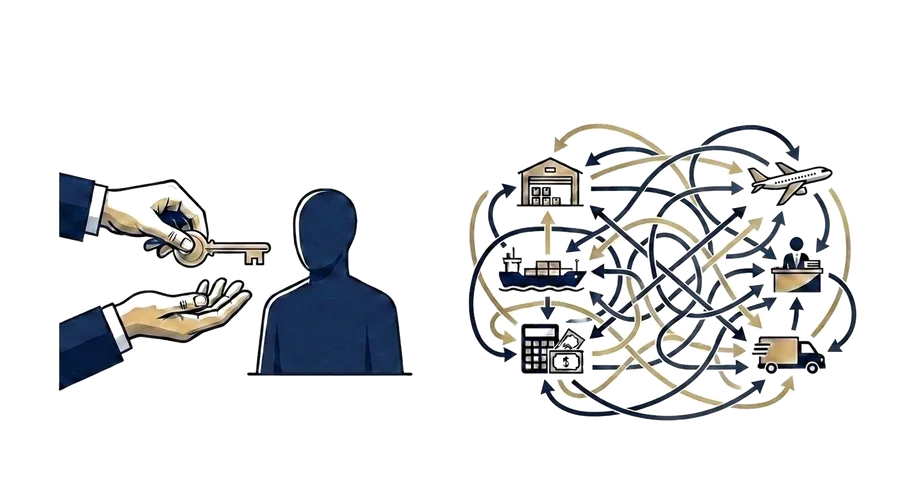
Hand over control
A local distributor takes on the market for you. The customer relationship and part of the margin sit with the distributor.
-
The usual detour
Or juggle it alone
Appoint a classic logistics vendor and you keep the customer. But you carry the customs, the import VAT, the returns, and the regulatory layer at every seam, where any gap stops the sale.
THE THIRD WAY, RESOLVED
Every barrier, folded into the same operation.
Your stock clears, stores, and ships from the same European operation, so you never manage a handover between vendors. The base runs on licensed bonded infrastructure operating since 2005.
This is the part neither alternative can offer. A local distributor clears the barriers and runs the market, so the customer relationship and part of the margin sit with it. A classic logistics vendor stores and ships. It then hands the customs, the import VAT, the representation, and the returns back to the brand to run at the seams. Here, the brand keeps the customer and the margin, with one point of contact for the whole European side.
-
Control and profitability
The brand keeps its margin and its direct line to European buyers. The customer relationship and the data stay with the brand, never with a middleman.
-
European presence
The brand operates, ships, and integrates as a local European operation. A European buyer receives a delivery from inside the EU, not a foreign import from outside the union.
-
Operational simplicity
The border friction and the scattered chain of vendors are replaced. The importer standing, the customs intake, the VAT, the fulfilment, and the returns all run together.
THE COMPARISON
Three routes into Europe, side by side.
Through the distributor
You do
You do
Shared with the distributor
Yours, minus your own coordination
Entirely yours
Handled by them
Not included
GPSR Responsible Person, VAT, Importer of Record
Handled by the distributor
Arranged separately
Run inside the operation: released on arrival, or under bond where it suits
Through the distributor
Yours to manage
Handled locally
Through the distributor's name
A foreign supplier, local warehouse
A local European operation
The comparison runs across customer ownership, margins, regulation, customs and tax, and returns. EFC is the column of the three that keeps the client, the margin, and the compliance work together, inside the same European operation.
THE THIRD WAY
From the outside,
Europe is an obstacle course.
Reaching the European market from outside means clearing several barriers in sequence. Each needs separate expertise, and any gap stops the whole sale.
Inside the EFC operation, those barriers are not a sequence the brand runs alone. The importer function, the customs intake, the VAT registration, and the returns are part of the same base.
EFC is the third way.
A distributor takes the customer and the margin.
A classic 3PL leaves you the customs and the tax at the seams.
Questions
The third way, answered straight.
What is the difference between a classic 3PL and EFC?
A classic third-party logistics vendor stores and ships your goods. It leaves customs, import VAT, fiscal representation, and the regulatory layer to you and to external brokers at the seams. EFC runs those inside the same operation: customs clearance and import handling in-house, release on arrival or storage under bond, and the Importer of Record function. It also runs OSS VAT on sales to consumers and the GPSR Responsible Person role for in-scope consumer products. You keep what a 3PL gives you and lose the complexity a 3PL leaves behind.
When does a local distributor still make sense over EFC?
A distributor can make sense when a brand wants someone else to own demand creation, local selling, and the customer entirely. It fits a brand that is willing to give up the margin and the relationship for that. EFC suits a brand that wants to keep the customer, the margin, and the data while still operating physically inside Europe. The honest line is that a distributor takes the market with it, and EFC keeps the market yours.
Can I switch to EFC if I already work with a distributor or a 3PL?
Yes. Brands commonly add the EFC model to reach countries their distributors do not cover, or to hold stock inside the EU for them. They also move when a 3PL has left them carrying customs and VAT. The operation takes over the customs intake, the VAT, and the fulfilment, and provides the importer of record where the import setup needs it. The transition is about moving stock into the base and pointing orders at it. What changes is who carries the complexity, not who owns your brand.
Who handles customs and tax in the EFC model?
Customs clearance and import handling run inside the operation. Stock is usually released for free circulation on arrival; higher-value goods can wait under bond, paying duty and import VAT at each release. OSS covers VAT on cross-border sales to consumers. The Importer of Record function lets a non-resident brand import legally. In the distributor model these are out of your sight, and in the classic 3PL model they are left to external brokers. With EFC they run inside the same operation.

Keep the customer.
Keep the margin.
Operate as a local European base.
See how the customs intake works, and how the European operation runs. Tell us what you ship and where it goes.
Get a quote