
THE OPERATING SEQUENCE
The border moves from every order to one intake. Everything else is a consequence of that.
EFC runs your stock from inside the EU customs union, the area where one set of EU customs rules applies. Bulk stock meets the customs border once, at intake, not on every parcel. Every order then moves within the EU with no customs step.

THE SHIFT
Most of what looks like cost in EU entry is one cost repeated.
Most of what looks like cost and friction in selling into the EU is one cost repeated: a customs border on every parcel. Instead of speeding up that step, we take it out of each order.
Holding stock inside the customs union does exactly that, because the goods cross the border once and then stop being imports.
HOW IT FITS TOGETHER
Why the six operations run as one.
Warehousing, Fulfillment, Compliance, Assembly, Last mile, Returns. We run the six together because they share one customs position: stock that has entered the EU customs territory once. That shared position is the asset.
We hold the stock, assemble it, dispatch it and take back returns, all as one operator. For in-scope consumer products we also act as Responsible Person under the General Product Safety Regulation (GPSR), the EU contact for product safety authorities. The value is not separate services sold together at a discount. It is one customs status that every operation draws on. Split the operations across providers, and the single-clearance advantage is lost.
- Warehousing
- Fulfillment
- Compliance
- Assembly
- Last mile
- Returns
A single customs position
THE SEQUENCE THAT FOLLOWS
One import on intake, then an operation inside the EU.
We run these steps as one operation, in this order.
-
Bulk import. Your stock enters the EU as consolidated stock, in one import.
-
Authorised consignee. Some goods arrive under transit, a customs procedure that suspends duty and import VAT on the way. The warehouse holds authorised consignee status, a customs authorisation to receive transit goods on site. So the movement ends at the warehouse instead of at a customs office.
-
One customs clearance. On the usual route, the goods are released for free circulation at intake, which makes them EU goods. Duty is paid then. Where the importer qualifies, import VAT goes in the VAT return.
-
Or under bond. Higher-value goods that move in smaller volumes can stay in the bonded customs warehouse. There, duty and import VAT are suspended until each release, under the Union Customs Code, Regulation (EU) No 952/2013.
-
Systems integration. Your store and ERP connect to the operation. You see stock and movements in the warehouse-management system.
-
Dispatch inside the EU. Once released, orders reach EU customers with no customs step on the way.
-
Local returns. Returns come back to us inside the EU and are handled there.
Released goods become Union goods, meaning goods with EU customs status. An order to another member state is then a delivery inside the single market, not a new import.
The model is not clever in operation. It is clever in position. Once the border is behind the stock instead of in front of each order, the operation that runs on top of it can be ordinary. Choosing which markets to build, and then growing them, is work we do too, in Business development.
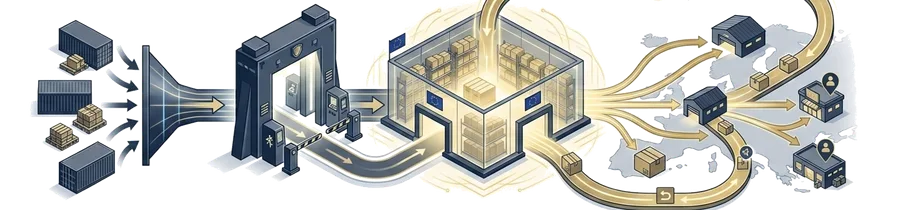
THE SEQUENCE, DRAWN
One customs entry on arrival, then reach across the EU.
Your stock enters in bulk through one customs point and stays inside the customs union. It is usually released for free circulation on arrival, or held under bond for higher-value goods. From there, each order goes to its EU market from inside the EU, not as a new import.

THE REMOTE OPERATION
Run your European operation from anywhere.
It runs as one operation. Your stock sits inside Europe, in bonded storage where needed, and you direct it from wherever you are. The operation is in the market, so your team does not have to be.
WHAT RUNS UNDERNEATH
The customs setup and the remote operation.
We run the warehouse, the bonded customs operation and the freight with our logistics partner, Warelog. We add market access, order fulfillment and the link to your store and ERP. For you, it is one operation with one person to call.
- Bonded customs warehouse Stock can be held in a bonded customs warehouse, so duty and import VAT are deferred until the goods are released.
- Authorised consignee Where goods arrive under transit, authorised consignee status held at the warehouse lets the movement end on site instead of at a customs office. The goods are then declared for release, or placed under bond, at the warehouse.
- Duty and import VAT deferred Under bond, duty and import VAT are suspended until each release, so stock not yet released carries no border tax.
- Systems integration Systems integration connects your store and ERP to the warehouse, so you can run the European operation from anywhere.
PRICING
We do not publish a rate card.
A single rate card would overcharge a simple operation and undercharge a complex one.
So we price each operation from the four things that drive its cost.
- Storage footprint
- How much space your stock takes up, and the conditions it has to be kept in. Bulky goods, or goods that need controlled conditions, cost more to store.
- Order volume
- How many orders ship, and how they spread across the year. Volume sets the daily work of picking, packing and dispatch.
- Handling complexity
- What each order asks of the warehouse floor: lines per order, packaging, inserts, labels and any assembly. The same order count can hide very different amounts of work.
- Compliance scope
- What the product needs before it can reach customers. For an in-scope consumer product, we take the Responsible Person role under GPSR, Regulation (EU) 2023/988. That role is the EU contact point for safety authorities.
A driver that does not apply to your goods adds nothing to the price. The proposal we send after a call names what is in scope and how each driver applies to your operation.
The mechanism, questioned
What brands ask about importing once and selling from inside the EU.
Once bulk stock is inside the customs union, the border stops being an event that repeats with every shipment. Stock is usually released for free circulation on arrival, or held under bond and released as needed. Orders then move within the EU with no customs step.
What is free circulation, and why does it matter?
On release for free circulation, the goods take the customs status of Union goods under the Union Customs Code, Regulation (EU) No 952/2013. Goods already in free circulation are not imported again. So onward orders are not the low-value imported consignments that the 2026 customs reform charges per item.
Does EFC only run the operation, or does it also help develop the market?
Both. The sequence on this page is the operation. Business development runs as one continuing engagement. It covers market and competitor research, the go-to-market strategy, and managing the market with you month after month. Chains, distributors and partners are part of that work, not the whole of it. In Europe, the same team also handles the customs, VAT, import, stock and delivery described here. EFC does not guarantee that the work leads to a meeting, a sale, or another commercial result.
How long does it take to get a brand operating?
EFC takes you from the first call to a live EU operation: bulk intake, customs clearance, systems integration and first dispatch. EFC manages that sequence, so you do not have to.

GET A QUOTE
Talk to the operations team
On a call we cover your volumes, your products and the operations we would run for you inside the EU. Send a few details and our operations team will reply.
Get a quote